


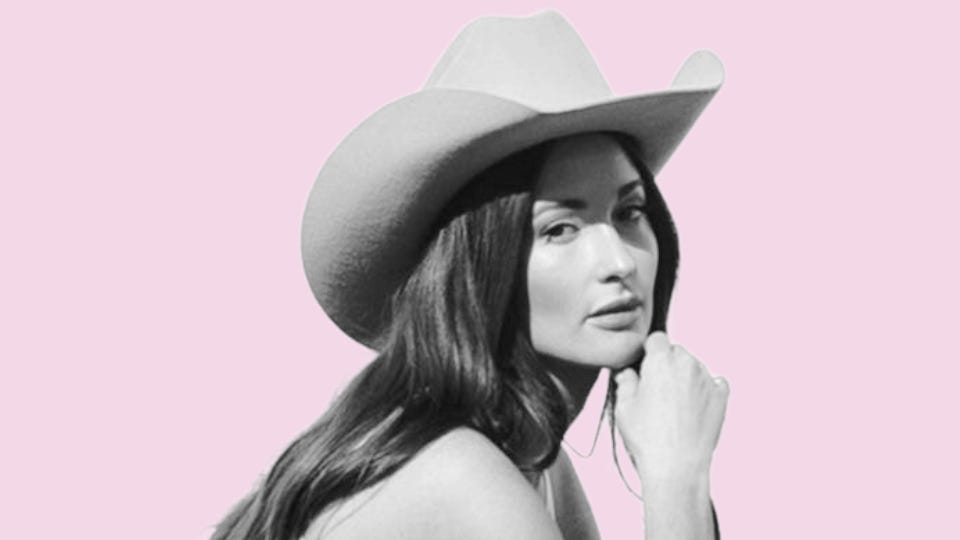
Kacey Musgraves, the Grammy-winning singer-songwriter from Golden, Texas, isn’t done with Middle of Nowhere—her recent traditional country record featuring pedal steel, Western swing, and guest appearances from Willie Nelson, Miranda Lambert, and Billy Strings.
She’s taking it south.
On Oct. 22, she announced Middle of Nowhere Vol. 2: Tex Mex Tapes, out Jan. 15. Four of its 16 songs are sung entirely in Spanish, per Billboard, and the first two singles, “Weekend in Texas” and “Mi Tesoro,” came out the same night.
The timing is hard to miss. Musgraves, who has never shied away from politics, releases the album as deportations approach record levels and the Trump administration’s enforcement push falls hardest on Texas’s Latino communities.
Musgraves has criticized masked ICE agents, and at her Chicago tour opener she asked fans to support the Young Center for Immigrant Children’s Rights: “It’s not a political thing. It’s just, these kids need help.” This month the White House used her “Mexico Honey” in a deportation TikTok; the audio has since been pulled.
On Oct. 6, she released a Spanish-language “Uncertain, TX” with Intocable, the Tejano giants from Zapata, Texas.
Watch: Kacey Musgraves and Intocable perform ‘Uncertain, TX’ (Spanish Version)
It’s her first song recorded entirely in Spanish, sung with frontman Ricky Muñoz. The original, a duet with Willie Nelson from May’s Middle of Nowhere, was already a No. 1 on Texas radio.
Watch: Kacey Musgraves, Willie Nelson perform ‘Uncertain, TX’
In Dallas, five days after releasing the single, she brought out the Mariachi Brothers, three teenagers from McAllen, for “Tú Sólo Tú,” “(Hey Baby) Qué Pasó” and “Uncertain, TX.”
In February, ICE detained the brothers and their parents at a routine check-in. After about two weeks in custody, and a push from their Republican congresswoman, they were released. Musgraves invited them to open her May release shows at Gruene Hall in New Braunfels, where they played “El Son de la Negra” and “La Bamba,” then joined her for “Tú Sólo Tú,” CNN en Español reported. (Watch a clip.)
Watch: McAllen mariachi brothers say opening for Kacey Musgraves among biggest performances of careers
In March, Musgraves told NPR she grew up hearing Mexican music all over East Texas and now spends about half her life in Mexico. Mariachi, she said, is Mexico’s version of folk country. “Texas would not be Texas without Mexico in many ways.”
She’s right. Through the 1700s, Texas was the northern edge of New Spain, and Mexican vaqueros were working cattle there long before Anglo settlers arrived. Texas broke from Mexico in 1836, and the U.S. annexed it in 1845, the same year German settlers founded New Braunfels. German and Czech immigrants brought the button accordion, the dance hall, and the polkas, waltzes, and schottisches that would shape Texas music in two languages. The 1848 Treaty of Guadalupe Hidalgo made the Rio Grande the border, but the Mexican families north of it stayed, and so did their music.
By the late 1800s, the accordion had reached South Texas and northern Mexico, and in Jalisco mariachi was taking shape as a string band. Mariachi Vargas de Tecalitlán, formed there in the 1890s, still sets the standard for “El Son de la Negra” and “La Bamba.”
By the 1920s, Tejano musicians had paired the accordion with the 12-string bajo sexto to create conjunto, which historian Manuel Peña called “the everyday music of working-class Texas Mexicans.” In northern Mexico, the same pairing became norteño.
In the 1930s, Narciso Martínez, the father of conjunto, started recording, and Lydia Mendoza cut “Mal Hombre.” Mexico City radio and film added trumpets to mariachi.
Watch: ‘Mal Hombre’ performed by Lydia Mendoza
From the same dance-hall polkas and waltzes, Bob Wills and his Texas Playboys built Western swing and wrote “San Antonio Rose.”
Watch: ‘San Antonio Rose’ by Bob Wills
The two sounds traded freely: Beto Villa, the father of the orquesta tejana, brought big-band swing to Tejano music in the late 1940s with Martínez on accordion.
Watch: ‘Pachuca Blues’ by Beto Villa with Narciso Martínez
In 1969, Willie Nelson bought Trigger, a nylon-string Martin built for the Spanish-guitar market. He was chasing Django Reinhardt’s sound, but he ended up putting a Spanish guitar at the center of country music for half a century.
Watch: Willie Nelson playing ‘Nuages,’ by Django Reinhardt
His biographer Joe Nick Patoski notes that polka, the same music that gave conjunto its accordion, first got Willie out of the cotton fields. And when you hear Willie Nelson play polka music on his famous guitar, the similarities to traditional Tejano music are undeniable.
Watch: Willie Nelson & The Family Band perform ‘Beer Barrel Polka’
In the ’70s, Johnny Rodriguez became one of country’s first Mexican American stars with “Ridin’ My Thumb to Mexico”; Little Joe & La Familia became Tejano mainstays, with songs like “¿Qué Pasó?”; and Freddy Fender topped the country chart with the bilingual “Before the Next Teardrop Falls.”
Watch: ‘Ridin’ My Thumb to Mexico’ by Johnny Rodriguez
Watch: Freddy Fender performs ‘Before the Next Teardrop Falls’
Then came Linda Ronstadt. Raised in Tucson in a family that had straddled the border for generations, she released Canciones de Mi Padre in 1987: rancheras she learned from her father, arranged by Rubén Fuentes. It became the best-selling non-English-language album in U.S. history, and its “Tú Sólo Tú” is the same ranchera Musgraves now covers.
Watch: Linda Ronstadt performs ‘Tú Sólo Tú’ (You Only You)
In 1989, Doug Sahm and Augie Meyers formed the Texas Tornados with Fender and accordionist Flaco Jiménez, giving us “(Hey Baby) Qué Pasó” and “Who Were You Thinkin’ Of.” Jiménez also played on Ronstadt’s 1991 follow-up, Más Canciones. Radney Foster, from the border town of Del Rio, scored with “Just Call Me Lonesome” in 1992; Selena took Tejano to its peak with 1994’s “Amor Prohibido”; and Nelson made 1998’s Teatro with Daniel Lanois.
In the 2000s, Nashville pop-country artists mostly used Mexico as a vacation backdrop, in songs by Tim McGraw (“Mexicoma”), Alan Jackson (“Mexico, Tequila And Me”), Toby Keith (“Stays in Mexico”) and George Strait (“The Seashores of Old Mexico”). Strait went further on 2009’s Twang, singing José Alfredo Jiménez’s “El Rey” in Spanish.
Watch: George Strait perform ‘El Rey’
On their 2018 Smithsonian Folkways album Cruzando Borders, the San Antonio conjunto band Los Texmaniacs brought in Lyle Lovett to sing Woody Guthrie’s “Deportee.” The song is also known as “Plane Wreck at Los Gatos.” Guthrie wrote it after reading a 1948 newspaper account of a plane crash in California that killed Mexican farm workers being flown home, and the article never named the Mexican victims, calling them only “deportees.”
Watch: Los Texmaniacs perform ‘Deportee’ featuring Lyle Lovett
In early 2024, Mexican superstar Carín León and country singer Kane Brown released “The One (Pero No Como Yo),” a career milestone for both artists and a landmark crossover between American country and música mexicana. The song is a stripped-down bilingual breakup ballad, and it debuted live at the Premio Lo Nuestro Awards. León later made his debut at Nashville’s Grand Ole Opry, with Brown cheering him on from the audience, the first time a música mexicana artist had played country music’s most storied stage.
Watch: Carín León perform at the Grand Ole Opry
That’s the tradition Musgraves is stepping into, and Tex Mex Tapes goes back to the source. She told NPR that Mexican music shaped her “in ways that I wasn’t even aware of.” The songs she’s covering were carried for generations by Tejano and Mexican musicians, many from the same communities now facing deportation, and they were in Texas before Texas was Texas.
She also said a night at an Austin dance hall, where Latino couples, Black and older white cowboys shared the floor, inspired the record. Tex Mex Tapes brings that whole dance floor onto one record. It’s out Jan. 15.
And if you’d like to listen to more of the music I highlighted here, check out this article’s playlist on Spotify.