


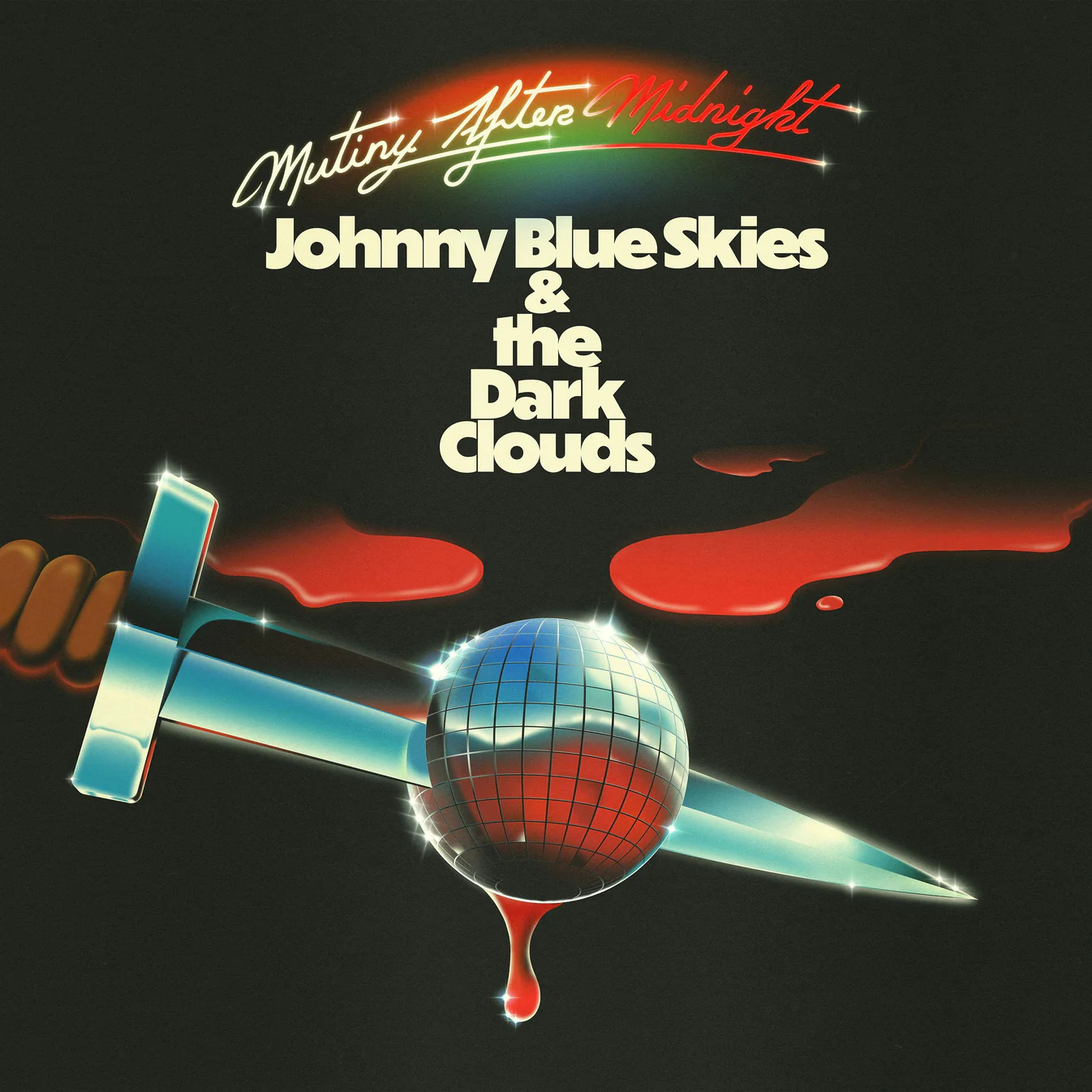
Nobody tells Sturgill Simpson what to do. Not Nashville. Not the labels. Not the algorithms. And not even the fans who want him to make Metamodern Sounds forever.
If you’ve been following his career, you already know this. Mutiny After Midnight is just the latest proof.
Think about the arc. He arrived in 2013 with Metamodern Sounds in Country Music — a record steeped in classic country tradition that made him an immediate darling of the alt-country world.
Then he made A Sailor’s Guide to Earth, a soul record dressed as a love letter to his son.
Then Sound & Fury, a psychedelic rock album accompanied by an anime film.
Then the Cuttin’ Grass bluegrass records.
Then The Ballad of Dood and Juanita, a western narrative that sounded like a 1950s radio play.
Then he retired the Sturgill Simpson name entirely. He’d promised five studio albums under his own name, he delivered five, and he was done. Enter Johnny Blue Skies — and now, with Mutiny After Midnight, Johnny Blue Skies & The Dark Clouds.
This album is a dance record. A groove record. Simpson has cited the ‘70s fusion supergroup Stuff and Marvin Gaye’s 1981 album In Our Lifetime as touchstones, and you can hear both all over it. It was recorded live at Dan Auerbach’s Easy Eye Sound Studios in Nashville with his band, the musicians he’s been on the road with for 13 years, and every song was written on the spot.
“I wrote words to what is happening in the world and my life in real time, and played with a group of musicians I deeply love and respect,” Simpson said. “Together, we made an album that is very fun and will hopefully offer some relief from darkness in the world.”
Make no mistake: this is a protest album. Simpson said as much himself. In his letter announcing the record, he wrote that the mutiny “is a protest against oppression and suppression, and the only tried and tested true antidote to that is pure, unfiltered, unapologetic, relentless disco-hedonism.” The dance floor as an act of resistance. Joy as defiance. It’s an old idea — Marvin Gaye knew it, James Brown knew it — and Simpson is working squarely in that tradition.
The nine tracks open with “Make America Fuk Again” and close with “Ain’t That a Bitch,” and the politics are explicit throughout. “Excited Delirium” directly takes on police and ICE brutality. “Everyone Is Welcome” addresses the grinding exhaustion of the rat race before turning nihilistic.
And “Ain’t That a Bitch” is a full-throated indictment — of the president, of oligarchs, of a democracy Simpson sees being systematically dismantled. The poor stay poor, the rich get rich, and nobody’s going to jail for any of it.
But Simpson doesn’t wallow. In between those bookends, he pivots hard to love, desire, and pure physical joy. He described the songs as falling into two categories, the dark state of the world and the bright state of love, and said the band chose to embrace those contradictions rather than resolve them. That tension is the whole point. It’s right there in the band name: Johnny Blue Skies & The Dark Clouds.
The album’s release was pure Simpson, too: announced as a physical-only record on vinyl, CD, and cassette, then posted to YouTube two weeks early after early copies got into the wild. You can read the original press release from Shore Fire Media here. The chaos of the rollout felt fitting for an artist who has never once done things the way he was supposed to.
That’s what makes Simpson one of the most valuable artists working in and around country music today. He doesn’t make records to satisfy expectations — his fans’, the industry’s, or anyone else’s.
He makes records because he has something to say and a band he believes in. Mutiny After Midnight is loose, alive, political, warm, and unlike anything else out right now. In a genre that too often rewards playing it safe, that matters.